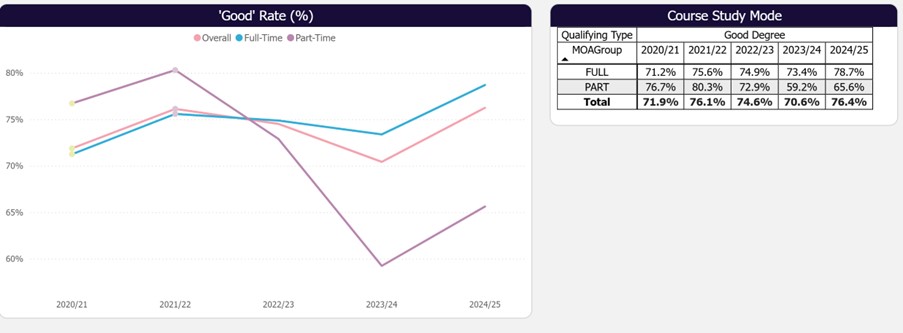
Table 1: University of Staffordshire good degrees by reporting year (MOA stands for Mode of Attendance)
The University of Staffordshire saw a rise in good degrees – that is, first-class or upper-second class degree classifications for its taught students from 71.9% in 2020/21 to a five-year high in 2024/25 of 76.4% (a rise of 4.5pp). This upward trend evidenced our investment in high quality teaching, notable infrastructure projects and innovative support and pastoral care initiatives as well as our commitment to high academic standards.
Until 2022/23, part-time good degree outcomes exceeded full-time results, reflecting strong performance among students from Armed Forces backgrounds. The subsequent decrease in 2023/24 (from 72.9% to 59.2%) was linked to the expansion of the Police Constable Degree Apprenticeship (PCDA), whose students now comprise nearly half of all part-time graduates.
In response to External Examiner feedback highlighting inconsistencies in marking, the PCDA team implemented a series of targeted actions, including staff training, module reviews, and the introduction of video assessment briefs to support student understanding and inclusive assessment. These interventions have led to improved consistency in marking and greater use of the full marking range, with good degree outcomes rising for part-time degrees to 65.6% in the current year.
For students with Indices of Multiple Deprivation (IMD) (for example those with barriers to education, employment and health), we have been working on closing the awarding gap between those from the most deprived backgrounds (IMD Quintile 1). The University has continued improvement in the awarding gap for Black students in 2024/25 compared with last year. Black students had a good degree achievement rate of 73.8% only 4.8pp lower than good degree awarding rates of students from White backgrounds (78.6%) This is sustained improvement over the past two years when the 2022/23 the awarding gap between Black and White students was 21.7pp. This is a reduction of 16.9pp However, the awarding gap for Asian students has increased 14.8pp compared with 8.4pp last year, an increase of 6.4pp.
We continue to address the awarding gaps with the most persistent risks of equality of opportunity through our Access and Participation Plan 2024 to 2028, as approved by the Office for Students (OfS).
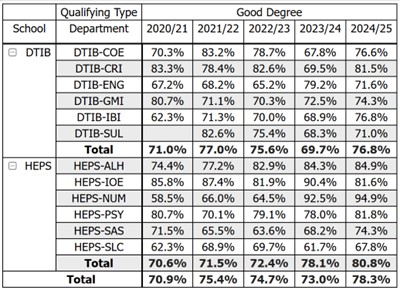
Table 2: Full-time good degrees by School
All Schools have developed local plans to reduce gaps in performance focusing on curriculum redevelopment and enhancements to learning and teaching approaches that promote greater academic stretch and achievement for all students.
A number of targeted interventions have contributed to the improved good degree outcomes for full-time students across our Schools, including:
- Enhanced progress monitoring: Monthly student progress reviews focusing on module attainment, with one-to one support sessions offered to students where issues are identified.
- Strengthened academic and language support: Increased input from the Academic Skills and Library team to improve the quality of students’ academic work. The English Language team has provided tailored support for students for whom English is not their first language.
- Inclusive teaching and assessment practices: University-wide neurodiversity training undertaken by staff has enhanced awareness of the diverse needs of the student population, supporting more inclusive and accessible approaches to teaching, learning and assessment.
- Peer mentoring and belonging initiatives: Implementation of peer mentoring schemes providing both academic and pastoral support for students from underrepresented groups, promoting a stronger sense of belonging and confidence in learning.
- Improved assessment and feedback practices:
- Introduction of vodcasts explaining assessment tasks, enabling students to revisit key guidance.
- Adoption of consistent feedback approaches that encourage students to reflect on and apply feedback to future assessments.
- Professional preparation in Nursing: Continued use of the University’s state-of-the-art simulation facilities to prepare Nursing students for professional practice.
These collective initiatives have strengthened the quality of learning, teaching and assessment, enhanced inclusivity, and contributed to sustained improvements in student attainment across the University.